If you have ever seen a message ending with a small ~ symbol, you may have wondered what it means.
This little mark is called a tilde, and its meaning can change depending on where and how it is used.
In texting, social media, and casual online conversations, it can add a playful, soft, uncertain, or relaxed tone to a message.
In other settings, it can mean approximately, refer to a special technical value, or represent a specific concept.
People often search for the ~ meaning in text because symbols do not always have one fixed definition.
A tilde in a mathematical formula is not necessarily doing the same job as a tilde at the end of a WhatsApp message. Context matters.
Understanding this symbol can make online conversations easier to read. It can also help you understand whether someone is being casual, playful, uncertain, sarcastic, or simply using a formatting habit.
Meaning & Definition
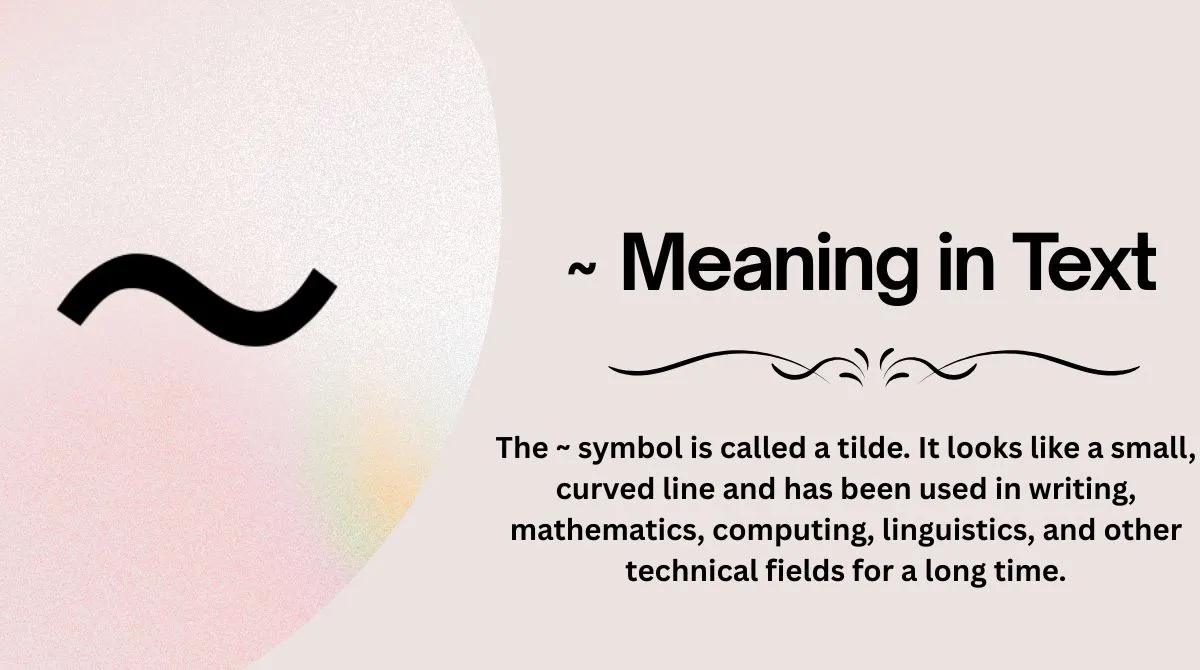
The ~ symbol is called a tilde. It looks like a small, curved line and has been used in writing, mathematics, computing, linguistics, and other technical fields for a long time.
In everyday texting, the tilde usually does not have one strict dictionary-style meaning. Instead, people use it to change the tone of a message. For example, someone might write:
- Hey~
- Thank you~
- Okay~
- Goodnight~
- See you later~
In these examples, the symbol can make the sentence feel softer or more playful. Without it, Goodnight may sound simple and direct. With Goodnight~, the message can feel more relaxed, cute, teasing, or affectionate.
Sometimes people use the symbol to stretch a sound or create a musical feeling. A person might write hellooo~ or sureee~ to make the message sound exaggerated or playful.
The symbol can also indicate uncertainty or approximation. For example, It will take ~10 minutes usually means approximately 10 minutes.
Therefore, the meaning depends heavily on the surrounding words. In a casual chat, it is often about tone. In a technical sentence, it may have a precise meaning.
The simplest way to understand it is this:
In texting, ~ often adds a soft, playful, casual, teasing, or expressive tone, while in technical contexts it can mean approximately or represent a specific relationship or notation.
Background of the Tilde Symbol
The tilde has a much older history than modern texting. It was not created for social media, dating apps, or smartphones. Its uses developed across different writing and technical systems.
The word tilde comes from a historical tradition of using a small mark above a letter. Over time, the symbol became associated with different linguistic and technical purposes. In Spanish, for example, the tilde is used as a diacritic in words such as ñ, where it changes the pronunciation and identity of the letter.
As writing systems developed, the symbol also found a place in mathematics, science, computing, and programming.
Modern computers made the tilde easy to type, which helped expand its use. It appears on many standard keyboards and became especially common in online communication. Because digital conversations lack many of the emotional cues found in face-to-face speech, users began experimenting with punctuation to express tone.
A period can make a message sound final. An exclamation mark can add excitement. Multiple question marks can show surprise or confusion. A tilde can create a softer or more playful feeling.
Internet culture also helped turn ordinary punctuation into a form of emotional expression. People began using symbols creatively rather than strictly according to traditional grammar rules.
This is why the ~ meaning in text can feel confusing to someone who learned punctuation mainly through formal writing. Online communication often treats punctuation as part of the personality and mood of a message.
Today, the tilde can therefore serve two very different roles. In technical writing, it may have a defined function. In casual messaging, it may simply communicate vibe.
Usage in Different Contexts
The tilde appears in many areas, and its meaning changes depending on the situation.
Casual texting
In ordinary messages, it can make a statement sound less serious or more playful.
Sure~ may feel softer than Sure.
Okay~ may sound relaxed or teasing.
Bye~ can feel more cheerful or affectionate.
Social media
People sometimes use it in captions, comments, usernames, or posts to create a particular aesthetic. It can make text look cute, informal, dramatic, or stylized.
For example:
Weekend vibes~
Here, the symbol is mostly decorative and expressive.
Approximation
In mathematics and everyday writing, ~ can mean approximately.
~50 people attended.
This means the number is around 50 rather than exactly 50.
Linguistics
The tilde can appear in linguistic notation to represent pronunciation or relationships between forms.
Mathematics and science
Depending on the field, it can indicate approximate equality, similarity, or another mathematical relationship.
Computing
The symbol has several programming and computing uses. In some environments, it may represent a home directory, a special operator, or part of a command.
Because of this variety, you should never assume that every tilde means the same thing.
The best clue is the environment. If it appears after Hey, it is probably expressing tone. If it appears before a number, it may indicate approximation. If it appears in a technical formula, its meaning may be much more specific.
Meaning in Chat, WhatsApp, Instagram, and TikTok
On messaging and social platforms, the tilde is usually about tone rather than literal meaning.
In chat
Someone might write:
What are you doing~
This could sound playful, curious, or slightly teasing.
Compare it with:
What are you doing?
The second version is more direct. The tilde gives the first version a more relaxed feel.
On WhatsApp
WhatsApp conversations are usually informal, so the symbol can appear naturally in friendly messages.
Good morning~
may sound warmer or more cheerful than simply Good morning.
However, you should not automatically interpret it as flirting. Friends can use it too.
On Instagram
The tilde may appear in captions or comments for style.
Living my best life~
Here it mainly adds personality.
On TikTok
TikTok comments often use unusual punctuation, repeated letters, emojis, and symbols to communicate internet-style humor. A tilde can make a phrase feel exaggerated, cute, dramatic, or intentionally unserious.
For example:
Stoppp~
could communicate playful protest rather than genuine anger.
The exact interpretation still depends on the person’s normal writing style. If someone regularly uses ~, it may simply be their preferred punctuation.
Meaning in Physics, Medical, and Aircraft Terminology
The tilde has meanings outside casual conversation, so technical context is especially important.
In physics
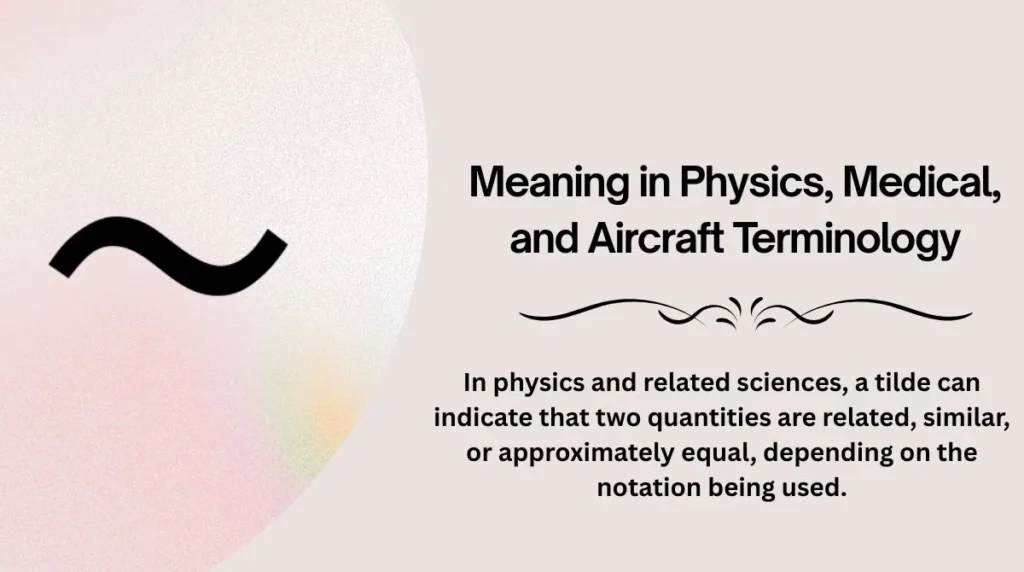
In physics and related sciences, a tilde can indicate that two quantities are related, similar, or approximately equal, depending on the notation being used.
For example, a scientist may use a tilde to communicate that a value is roughly a particular amount. It can also appear in specialized equations and notation.
Therefore, ~ in physics should not automatically be interpreted as the playful texting symbol.
In medical terminology
Medical writing can use many symbols and abbreviations, and the tilde may appear in specialized documentation, scientific literature, or technical notation. Its meaning depends on the specific system being used.
It may indicate approximation or form part of a specialized notation rather than expressing emotion.
If you encounter it in a medical report, prescription-related material, or scientific paper, the surrounding terminology is essential for interpreting it correctly.
In aircraft and aviation terminology
Aviation uses highly standardized language, symbols, abbreviations, and technical documentation. A tilde may appear in technical material, diagrams, mathematical calculations, software documentation, or other specialized contexts.
It should not automatically be read as a casual texting symbol.
For example, if you see ~5,000 ft in a technical context, the tilde may indicate an approximate altitude rather than a playful tone.
The key lesson is simple: the symbol stays the same, but its job changes with the context.
Common Misconceptions About the Tilde
One common misconception is that the tilde always means flirting.
That is not true.
Someone writing Hey~ might be flirting, but they might also simply have a playful writing style. You need to consider the conversation, relationship, and person’s usual texting habits.
Another misconception is that the symbol always means approximately. This is also incorrect. Approximation is common in mathematical and technical contexts, but a person writing Hi~ is not saying approximately hi.
Some people also assume that a tilde automatically indicates sarcasm. Again, context matters. It can contribute to a sarcastic tone, but the symbol itself does not guarantee sarcasm.
Another mistake is assuming that every unusual punctuation mark carries a secret code. Online communication is flexible. People often use punctuation simply because they like how it looks or sounds.
For example:
Thank you~
could mean:
- Thanks in a cute way
- Thanks in a playful way
- A softer thank-you
- A teasing thank-you
- A personal texting habit
There is no universal translation.
The safest approach is to read the entire message rather than focusing on one symbol. Look at the words before it, the relationship between the speakers, and the overall tone.
Similar Terms & Alternatives
Several symbols can perform similar jobs in casual digital communication, although they are not identical.
| Symbol | Common casual effect |
|---|---|
| ~ | Soft, playful, relaxed, expressive |
| … | Hesitation, uncertainty, trailing thought |
| ! | Excitement, emphasis, energy |
| ? | Questioning or uncertainty |
| !! | Strong excitement or emphasis |
| 🙂 | Friendly or warm tone |
| <3 | Affection or love |
| — | Pause, interruption, or emphasis |
The tilde is especially interesting because it can change the emotional texture of a sentence without changing its basic meaning.
Compare:
Okay.
Okay!
Okay?
Okay…
Okay~
Each version communicates something different.
The first can feel neutral or final. The second sounds energetic. The third asks for confirmation. The fourth may suggest hesitation. The fifth often feels softer, playful, or teasing.
Of course, these interpretations are not universal. People have individual texting styles.
The best alternative to the tilde depends on what you are trying to communicate. If you want warmth, an emoji might work. If you want excitement, an exclamation mark may be better. If you want hesitation, an ellipsis can make more sense.
How to Respond When Someone Uses ~
If someone sends you a message containing ~, you do not need to respond to the symbol itself. Respond to the meaning of the whole message.
For example, if someone says:
Hey~ What are you up to?
You could reply naturally:
Not much! Just relaxing. You?
If the conversation is playful, you can match the tone:
Trying to survive Monday~ How about you?
If you think the person is flirting, you can respond playfully without assuming too much:
That little ~ makes that message suspiciously charming.
For a friend, keep it casual:
Haha, what’s with the dramatic tilde?
If you are unsure what they mean, simply continue the conversation normally.
There is usually no need to ask, What does your tilde mean? That can make a normal conversation feel unnecessarily formal.
Instead, watch the broader pattern. Does the person compliment you? Start conversations? Tease you? Use affectionate language? Send playful messages? Those clues are more useful than the tilde alone.
Remember that punctuation is a supporting signal, not definitive proof of someone’s intentions.
Differences From Similar Words and Symbols
The tilde can be confused with several other punctuation marks and symbols.
Tilde vs. hyphen
A hyphen looks like – and is commonly used to connect words or parts of words. A tilde looks like ~ and has different uses.
Tilde vs. dash
A dash is longer, such as —, and can indicate a break or interruption in a sentence. A tilde normally serves a different function.
Tilde vs. ellipsis
An ellipsis consists of three dots:
…
It often suggests hesitation, an unfinished thought, or a pause.
The tilde:
~
usually creates a softer or more playful effect in casual messaging.
Tilde vs. approximately
The word approximately expresses an estimated amount. The tilde can sometimes be used as a shorthand for that idea.
Approximately 20 minutes
and
~20 minutes
can communicate a similar idea in many contexts.
However, the tilde itself does not always mean approximately. Context decides.
Tilde vs. emoji
An emoji communicates emotion through a visual symbol. A tilde mainly changes the tone or style of written text.
These differences are useful because digital communication often combines several of them:
Okayyy~ 😄
The repeated letters, tilde, and emoji all contribute to the overall mood.
Relevance in Online Conversations and Dating Apps
The tilde can become especially interesting in dating conversations because small changes in punctuation may affect how a message feels.
Consider:
Hey
Hey!
Hey~
The first is neutral. The second feels energetic. The third may feel softer, playful, or slightly flirty.
But that does not mean Hey~ automatically means romantic interest.
Dating apps are full of ambiguous signals. People often use punctuation, emojis, GIFs, repeated letters, and casual slang to create personality. These details can help communicate tone, but they should not be treated as definite evidence of attraction.
For example:
You look good~
could be flirtatious.
But:
That outfit is cute~
could simply be friendly.
The surrounding conversation matters much more.
If someone repeatedly uses a tilde while teasing you, asking personal questions, giving compliments, and keeping the conversation going, the overall pattern may suggest interest. The symbol is simply one small piece of the puzzle.
The best approach on dating apps is to respond to the actual message rather than overanalyzing every punctuation mark.
If the conversation feels playful, match that energy. If it feels neutral, stay friendly. If you are interested, show interest through your words rather than relying on a single symbol to decode the other person’s feelings.
In other words, ~ can add a little flavor to a conversation, but it cannot tell you the whole story.
Conclusion
The ~ meaning in text depends almost entirely on context. In casual messages, the tilde often makes a sentence feel softer, playful, cute, relaxed, teasing, or expressive. A simple Hey~ can feel very different from Hey., even though the basic word remains unchanged.
Outside texting, the symbol can have more technical meanings.
It may represent approximation, similarity, or specialized notation in mathematics, science, computing, linguistics, and other fields.
That is why understanding the surrounding context is always important.
On WhatsApp, Instagram, TikTok, chats, and dating apps, do not treat the tilde as a secret universal code. It may suggest a certain mood, but the person’s words and overall behavior provide much stronger clues.
So, when you see ~, think of it as a flexible little symbol. Sometimes it adds meaning, sometimes it adds mood, and sometimes it is simply there because someone likes the way it looks.

Hi, I’m Eleanor Brooks, an English language writer passionate about making vocabulary, grammar, idioms, and everyday expressions easy to understand. I create clear, accurate, and practical content that helps learners build confidence and improve their English every day.