Have you ever received a message that simply says … and wondered what the person was trying to say? The three dots may look simple, but in texting, they can carry several meanings.
Depending on the conversation, … meaning in text message can suggest hesitation, silence, suspense, confusion, disappointment, awkwardness, or even that someone wants you to continue talking.
The symbol is called an ellipsis, and it has a long history in written language. In modern communication, however, people often use it differently from traditional grammar rules.
A friend might send three dots because they do not know what to say. Someone on Instagram might use them to create suspense. In a dating conversation, they can even make a message sound mysterious or slightly flirty.
Understanding the situation is important because … does not have one fixed meaning. The message before it, the relationship between the people, and the tone of the conversation can completely change its meaning.
Meaning & Definition
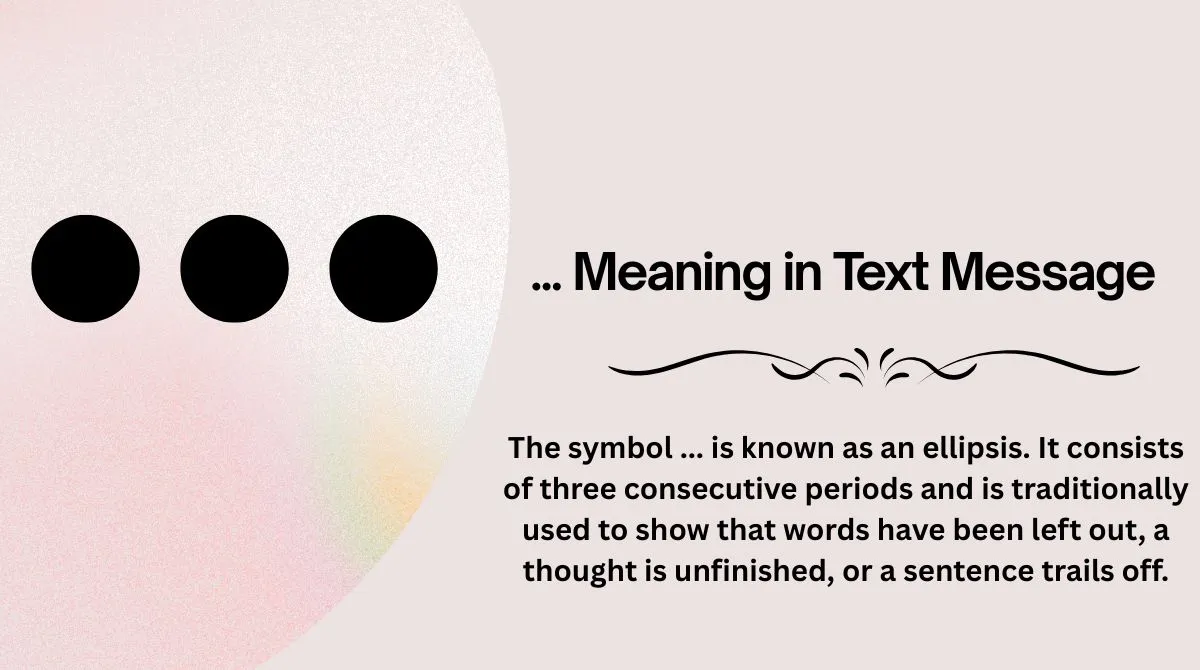
The symbol … is known as an ellipsis. It consists of three consecutive periods and is traditionally used to show that words have been left out, a thought is unfinished, or a sentence trails off.
For example:
- I was going to tell you something…
- Well… I don’t know.
- If you really want to know…
- Maybe we should…
In ordinary writing, an ellipsis can indicate that a speaker has paused or stopped before finishing a thought. In text messages, however, its meaning is much broader.
When someone sends … by itself, they may be communicating silence without actually saying the word silence. It can feel like a pause in a conversation. Sometimes it means, I have no words. Other times, it can mean, I’m waiting for you to explain.
The emotional meaning depends heavily on context. Consider these examples:
Person A: I forgot your birthday.
Person B: …
Here, the dots may suggest disappointment, shock, or that the person does not know how to respond.
Now consider:
Person A: I have a surprise for you…
Person B: What is it?
Here, the ellipsis creates suspense.
The same three dots can therefore communicate completely different emotions.
In texting, … may represent an unfinished thought, hesitation, awkwardness, uncertainty, suspense, disbelief, or a deliberate pause. It can also make a message sound more serious than it would with a normal period.
One reason people search for … meaning in text message is that digital communication removes many natural clues found in face-to-face conversation. We cannot hear someone’s voice or see their facial expression. A tiny punctuation mark can therefore become part of the emotional tone.
The safest interpretation is to look at the entire conversation instead of assuming that the three dots always mean something negative.
Background
The ellipsis is not a modern invention created by texting. It has been used in written language for a very long time. Traditionally, it indicates an omission or an unfinished statement.
For example, a writer may shorten a quotation by removing part of a sentence and replacing the missing words with an ellipsis. In ordinary prose, it can also represent a pause or a thought that fades away.
Over time, the symbol became common in informal writing. Messaging apps and social media then gave it a new personality.
Digital communication is different from traditional writing because people often use punctuation to express emotion. A period can sometimes feel more serious in a text than it does in ordinary writing. Likewise, three dots can create a feeling of uncertainty or tension.
Compare these messages:
Okay.
Okay…
Okay!
They all contain the same basic word, but the punctuation changes the mood.
Okay. may sound neutral or firm.
Okay… may sound uncertain, hesitant, disappointed, or suspicious.
Okay! usually sounds energetic or enthusiastic.
This is why punctuation matters so much in texting. People do not simply read the words. They also interpret spacing, capitalization, emojis, punctuation, and message length.
The ellipsis became especially useful because it imitates the pauses people make when speaking. Imagine someone saying:
Well…
That pause can communicate uncertainty without requiring an explanation.
In modern online conversations, the symbol can also be used intentionally for dramatic effect. Someone might write:
So you finally decided to show up…
The dots make the sentence feel different from:
So you finally decided to show up.
The first version may sound teasing, suspicious, annoyed, or playful.
The exact meaning is therefore shaped by both the historical purpose of the ellipsis and modern texting habits. What began as a punctuation mark for omissions and unfinished thoughts has become a flexible tool for expressing emotion online.
Usage in Different Contexts
The meaning of … changes significantly depending on where it appears. A punctuation mark used in a formal report should not automatically be interpreted the same way as one used in a group chat.
In casual chat
Friends may use three dots to show hesitation or an unfinished thought.
I thought you knew…
This could mean the speaker is surprised, disappointed, or unsure how to continue.
In arguments
The ellipsis can make a message sound skeptical or frustrated.
Sure… if that’s what you think.
Here, the dots may suggest that the sender does not genuinely agree.
In jokes
Three dots can build suspense.
Guess what happened today…
The reader naturally wants to know what comes next.
In storytelling
An ellipsis can create drama.
He opened the door and saw… nothing.
The pause makes the moment more dramatic.
In professional communication
The meaning is usually more literal and should be interpreted carefully. An ellipsis may indicate an omitted portion of a quotation or an unfinished statement.
For example:
The report states that the company will…
In professional writing, using excessive ellipses can make communication seem uncertain or informal.
In social media
People often use … for dramatic effect, sarcasm, suspense, or humor.
A post might say:
Me pretending I didn’t see that message…
The dots create a conversational and playful tone.
In personal relationships
The symbol can become more emotionally loaded. A partner or friend who normally writes complete sentences may suddenly send …. That change in style may indicate confusion, annoyance, disappointment, or simply that they do not know how to respond.
The key lesson is simple: punctuation has meaning, but context has more meaning.
Meaning in Chat, WhatsApp, Instagram, and TikTok
On messaging and social platforms, … is often less about grammar and more about emotion.
If someone sends:
…
by itself, they may be waiting for you to continue. It can also communicate awkward silence.
For example:
You: I have something to tell you.
Them: …
That response could mean Tell me, I’m waiting, or What is it?
But if you send:
You never told me the truth…
the dots suggest that the thought is emotionally unfinished.
On Instagram, ellipses often appear in captions, comments, and direct messages.
Someone might comment:
You actually did it…
Depending on the situation, this could express surprise, admiration, disbelief, or teasing.
TikTok
TikTok culture often uses punctuation dramatically. A creator might write:
When you realize who liked your video…
The dots create anticipation and encourage the viewer to keep watching.
Group chats
In group conversations, three dots can signal that someone is observing the conversation without immediately contributing.
Someone might respond:
Interesting…
That could be genuine curiosity, suspicion, sarcasm, or amusement.
Dating chats
The meaning becomes even more dependent on tone.
You look good in that picture…
could be flirtatious.
So that’s where you’ve been…
could sound suspicious.
I have an idea…
could be playful and mysterious.
This is why interpreting … meaning in text message requires more than translating the symbol into one definition. The same punctuation can communicate completely different emotions across WhatsApp, Instagram, TikTok, and ordinary texting.
Meaning in Physics, Medical, and Aircraft Terminology
The three dots can have meanings outside casual texting, but these meanings should not be confused with their conversational use.
Physics
In physics and mathematics, dots can represent several different things depending on notation.
A dot above a variable can indicate a derivative with respect to time. For example, a position variable may be written with a dot to represent velocity.
Multiple dots can also appear in mathematical notation, though … commonly indicates continuation in a sequence.
For example:
1, 2, 3, 4, …
Here, the dots mean that the pattern continues.
So if you encounter three dots in a physics or mathematics context, do not automatically interpret them as hesitation or emotion.
Medical terminology
In medical writing, three dots may appear when text has been intentionally shortened or when a quotation has been interrupted. Medical abbreviations and notation can also contain periods, but those should be interpreted according to the specific term.
In a patient message, however, … has the ordinary conversational meaning determined by context.
For example:
Doctor: Your results are available… let’s discuss them tomorrow.
Here, the ellipsis simply creates a pause.
It does not represent a special medical diagnosis or condition.
Aircraft terminology
Aviation has many technical abbreviations, codes, and standardized forms of communication. The ellipsis itself is not generally a universal aircraft-specific code meaning the same thing everywhere.
In an aviation document, three dots may appear as punctuation, an indication of continuation, or part of a particular document format. The surrounding material is necessary to understand it correctly.
This distinction matters because symbols can have specialized meanings in technical fields. A person reading … in a physics textbook is dealing with notation, while a person receiving … from a friend is interpreting tone.
Never assume that one meaning applies across every field.
Common Misconceptions
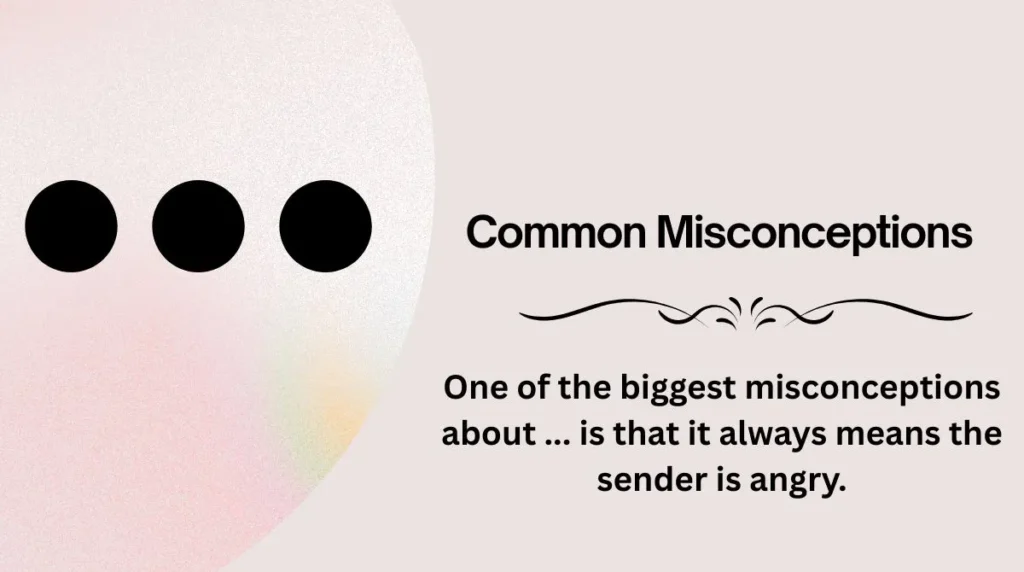
One of the biggest misconceptions about … is that it always means the sender is angry.
That is not true.
Three dots can communicate many things, including:
- hesitation
- uncertainty
- suspense
- awkwardness
- disappointment
- disbelief
- sarcasm
- curiosity
- an unfinished thought
- a dramatic pause
- waiting for someone to respond
Another common misconception is that … always means something negative.
For example:
I have a surprise for you…
is not necessarily negative. The sender may simply be building suspense.
Likewise:
You won’t believe what happened…
usually creates curiosity rather than anger.
Another mistake is assuming that everyone uses punctuation in exactly the same way. People have different texting habits. One person may use ellipses frequently because they naturally type the way they speak. Another person may use them only when they are upset or uncertain.
Age, culture, personality, platform, and relationship can also influence interpretation.
There is also a misconception that … has a secret universal code. It does not. There is no single emotional translation that works in every conversation.
Context is the deciding factor.
Look at the words around the punctuation, the previous messages, and the person’s normal texting style. If someone always uses three dots, it may mean very little emotionally. If someone normally uses exclamation marks and suddenly sends only …, the change may be more meaningful.
In short, do not panic when you receive three dots. Read the conversation before reading the punctuation as a warning sign.
Similar Terms & Alternatives
Several punctuation marks can create pauses or emotional shifts, but they do not all communicate the same feeling.
| Symbol | Common meaning in texting |
|---|---|
| … | Pause, hesitation, suspense, unfinished thought |
| . | Full stop, firmness, neutrality, or seriousness |
| .. | Informal pause or incomplete thought |
| ! | Excitement, emphasis, surprise |
| ? | Question, confusion, uncertainty |
| ?! | Surprise, disbelief, or strong questioning |
| — | Interruption, sudden change, or emphasis |
The ellipsis is especially useful when someone wants a sentence to feel unfinished.
For example:
I guess you’re right…
This sounds different from:
I guess you’re right.
The first version leaves emotional space after the statement. The second feels more final.
Other alternatives include phrases such as:
- Hmm
- Well
- Wait…
- I don’t know
- Seriously?
- Uh…
- Anyway
- And then…
However, these alternatives are more explicit. The ellipsis is subtle, which is exactly why it can sometimes cause confusion.
If you want to avoid misunderstanding, use clear words instead of relying entirely on punctuation.
Instead of:
Fine…
you could say:
I’m a little disappointed, but it’s okay.
Clear language reduces the chance that the other person will guess the wrong emotion.
How to Respond to It
Your response should depend on what the three dots appear to mean.
If someone sends only:
…
you can respond naturally with:
- What’s up?
- You okay?
- What are you thinking?
- Go on.
- Did I say something wrong?
- I’m listening.
- You can’t just send three dots and disappear 😂
If the person seems confused, give them room to explain.
If the message appears playful, you can match the tone.
Them: I have a secret…
You: Now you’ve got my attention.
If the message seems serious:
Them: I don’t even know what to say…
A supportive response could be:
Take your time. I’m listening.
If you’re unsure whether the person is annoyed, avoid immediately becoming defensive.
Instead of:
Why are you mad?
try:
Did something bother you?
That leaves space for clarification.
In dating conversations, you can respond playfully without assuming too much.
Them: So you finally noticed me…
You: Took me a minute, but I’m here now.
The important rule is not to overinterpret punctuation. If the meaning is unclear, ask.
A simple question can solve what ten minutes of analyzing punctuation cannot.
Differences From Similar Words and Symbols
The ellipsis is sometimes confused with a period, pause, or other punctuation. Although these symbols may appear similar, their conversational effects can be different.
Ellipsis vs. period
Okay.
sounds complete and final.
Okay…
sounds unfinished or emotionally open.
The period closes the thought. The ellipsis leaves the door slightly open.
Ellipsis vs. question mark
Really?
clearly asks a question.
Really…
may express disbelief, hesitation, disappointment, or suspicion.
The question mark directly signals questioning, while the ellipsis relies more heavily on context.
Ellipsis vs. exclamation mark
Wow!
usually expresses excitement or surprise.
Wow…
could express disbelief, awkwardness, amazement, or disappointment.
Ellipsis vs. dash
A dash can suggest interruption or a sudden change.
I was going to tell you—but never mind.
An ellipsis generally feels slower and softer.
I was going to tell you… never mind.
The dash can feel sharper. The ellipsis often feels more hesitant.
Ellipsis vs. silence
Three dots can represent silence in writing, but they are not literally silence. They are a visual way to suggest a pause.
That difference explains why … can feel emotional even though it contains no actual words.
Relevance in Online Conversations & Dating Apps
In online conversations, punctuation has become part of digital body language. Since people cannot hear your voice or see your facial expression, small signals such as punctuation help create tone.
The ellipsis is particularly powerful because it leaves something unsaid.
On dating apps, that can make conversations feel playful or mysterious.
For example:
I have a feeling we’d get along…
The dots make the message feel softer and more suggestive than a hard full stop.
Another example:
You seem interesting…
Depending on the conversation, this might be an invitation to continue talking.
But the same symbol can also create uncertainty.
So you’re still talking to your ex…
Here, the dots may suggest suspicion or concern.
Because dating conversations often involve emotional uncertainty, people can easily overanalyze small details. A three-dot response may suddenly become the subject of intense speculation.
Try not to assume too much from punctuation alone.
Consider:
- What did the person say before the dots?
- What is your relationship with them?
- Do they normally use ellipses?
- Is the conversation playful, serious, romantic, or tense?
- Did they change their usual texting style?
If someone normally writes:
Hey… how are you… what’s going on…
then the dots are probably simply part of their writing style.
If they usually write:
Hey! How are you?
and suddenly respond:
Fine…
the change in tone may be worth noticing.
On dating apps, the best approach is to respond to the overall message rather than obsessing over three punctuation marks.
Why Three Dots Can Feel So Emotional
The power of … comes from what it does not say.
A complete sentence gives the reader an ending.
An ellipsis gives the reader a gap.
That gap makes the reader mentally complete the thought.
For example:
If you knew what I was thinking…
The reader automatically wonders what the person is thinking.
Likewise:
Well, that’s one way to do it…
The sender may be impressed, sarcastic, amused, or annoyed. The reader has to interpret the emotional meaning.
This makes the ellipsis useful for humor and storytelling. It creates suspense without requiring extra words.
It can also make messages feel softer.
Compare:
I don’t know.
with:
I don’t know…
The second version may sound less final and more hesitant.
However, that emotional flexibility can also cause misunderstandings. One person may intend a harmless pause while the other interprets it as passive aggression.
This is especially common in short messages where there is little context.
If you are sending an important message, clear wording is usually better than depending on punctuation to communicate complicated emotions.
Frequently Asked Questions
What does … mean in a text message?
It usually represents a pause, hesitation, unfinished thought, suspense, uncertainty, or silence. Its exact meaning depends on the surrounding conversation and the sender’s usual texting style.
Does … mean someone is angry?
Not necessarily. Three dots can indicate anger or disappointment, but they can also express curiosity, suspense, hesitation, humor, or simple uncertainty.
What does it mean when someone sends only …?
A standalone … may mean that the person does not know what to say, is waiting for you to continue, is surprised, feels awkward, or wants you to explain something.
What does … mean from a girl or guy?
There is no gender-specific meaning. The interpretation depends on the person’s personality, the conversation, and the relationship between you.
Is … rude in texting?
It can sometimes feel rude or passive-aggressive, especially when used after a short response such as Okay…. However, many people use it casually without intending anything negative.
What should I reply when someone sends …?
If you are unsure, keep it simple. Try What’s up?, You okay?, What are you thinking?, or I’m listening. The best response depends on the conversation.
Conclusion
The meaning of … in a text message is not limited to one definition. The symbol, known as an ellipsis, can represent hesitation, silence, suspense, uncertainty, disbelief, awkwardness, or an unfinished thought. In casual texting, WhatsApp, Instagram, TikTok, and dating apps, its meaning is usually shaped by context and personal texting habits.
In technical subjects such as physics, mathematics, medicine, and aviation, dots can have completely different functions, so context becomes even more important.
If someone sends you three dots, do not immediately assume they are angry or upset. Look at the conversation as a whole. Their usual communication style often tells you more than the punctuation itself.
Ultimately, … works because it leaves something unsaid. Sometimes that creates suspense, sometimes emotion, and sometimes confusion. When in doubt, ask instead of guessing.
Meta Description:

Hi, I’m Eleanor Brooks, an English language writer passionate about making vocabulary, grammar, idioms, and everyday expressions easy to understand. I create clear, accurate, and practical content that helps learners build confidence and improve their English every day.