If someone sends you HAGD in a text message, comment, or direct message, you may wonder whether it is slang, an abbreviation, or something specific to the conversation.
In most casual online conversations, HAGD means Have a Great Day. It is a friendly way to end a conversation or wish someone well.
You may see HAGD in texts, WhatsApp messages, Instagram DMs, TikTok comments, online chats, and other informal conversations.
People often use it when they want to keep their message short without sounding unfriendly.
The abbreviation is especially useful when someone is wrapping up a conversation.
For example, a person might say, Thanks for your help, HAGD! Here, the meaning is simple: they are wishing you a great day.
Understanding short internet abbreviations can make online conversations much easier.
So, if you have recently come across HAGD and wondered what it means, you are in the right place.
HAGD Meaning & Definition
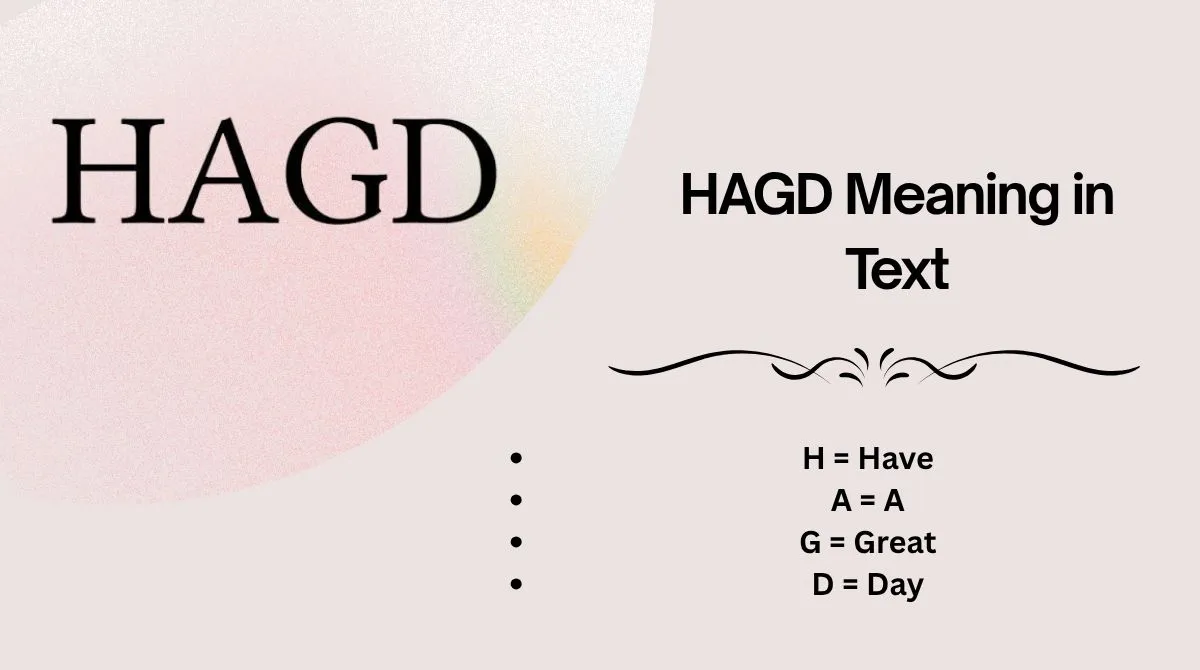
HAGD usually means Have a Great Day.
It is an informal abbreviation created from the first letters of the words:
- H = Have
- A = A
- G = Great
- D = Day
The phrase is generally positive, polite, and friendly. Someone may use it at the end of a conversation instead of typing the complete phrase.
For example:
- Thanks for sending that file. HAGD!
- I have to go now. HAGD!
- Good talking to you. HAGD!
- Hope everything goes well today. HAGD!
The tone is normally warm but casual. It does not automatically suggest flirting, friendship, or romantic interest. The meaning depends more on the surrounding conversation than on the abbreviation itself.
HAGD can also make a message feel quick and relaxed. Someone who is busy may prefer writing four letters rather than typing the full sentence.
It is worth remembering that abbreviations do not always have one universal meaning. However, in ordinary texting and social-media conversations, Have a Great Day is the most natural interpretation.
If someone sends you only HAGD after a conversation, they are probably simply ending the interaction on a positive note.
Background and Development
HAGD comes from a much larger habit of shortening common phrases in digital communication. As texting, instant messaging, and social media became popular, people began using abbreviations to communicate faster.
Expressions such as LOL, BRB, BTW, and TTYL became familiar examples of this style. HAGD fits the same general pattern. Instead of writing Have a great day every time, users can shorten the phrase to its first letters.
The abbreviation is particularly logical because Have a Great Day is a common closing phrase. People already understand the full expression, so shortening it does not usually create much confusion.
Unlike some internet slang, HAGD does not necessarily represent a complicated cultural trend. It is mainly a convenient shorthand.
Its tone also comes from the original phrase. Have a great day sounds positive and courteous, so HAGD generally carries the same friendly feeling.
Digital communication has also encouraged people to adapt language to different situations. A short abbreviation may feel natural in a text between friends but less suitable in a formal business email.
This distinction is important. Knowing what an abbreviation means is only half the job. You should also understand where and when it is appropriate.
For example, sending HAGD to a close friend is perfectly normal. Sending it to a professor, government official, or potential employer may sound too casual depending on the situation.
So, HAGD is best understood as a simple piece of informal digital shorthand rather than a complicated slang term.
HAGD in Different Contexts
The meaning of HAGD generally stays the same across casual conversations, but its tone can change depending on the situation.
In casual chat
A friend might write:
I have to head out. HAGD!
Here, it simply means Have a Great Day and acts as a friendly goodbye.
In social media
Someone may use HAGD when responding to a comment or ending a conversation in a direct message.
For example:
Thanks for explaining that! HAGD!
It keeps the interaction positive without requiring a long response.
In online communities
HAGD can be used by people who do not know each other personally. A user might finish a helpful response with HAGD as a polite closing.
In professional communication
This is where context matters most. HAGD is understandable, but it is usually informal. In a workplace message, a complete phrase such as Have a great day is often more polished.
For example, instead of:
I have attached the report. HAGD!
you might write:
I have attached the report. Have a great day.
The full phrase sounds more professional.
In customer conversations
Businesses and support workers may sometimes use the complete phrase rather than the abbreviation because clarity and professionalism are important.
Overall, HAGD works best when the conversation is relaxed and informal.
HAGD Meaning in Chat, WhatsApp, Instagram, and TikTok
On messaging and social-media platforms, HAGD normally keeps its basic meaning: Have a Great Day.
HAGD in chat
In ordinary texting, HAGD usually appears near the end of a conversation.
Example:
Person A: Thanks for helping me with that!
Person B: No problem. HAGD!
The abbreviation functions almost like a friendly goodbye.
HAGD on WhatsApp
WhatsApp users may use HAGD when ending a conversation with friends, family members, classmates, or other contacts.
Example:
I need to get back to work now. HAGD!
It is short and easy to understand.
HAGD on Instagram
On Instagram, HAGD may appear in DMs, comments, or casual interactions. Someone could use it after answering a question or finishing a conversation.
For example:
Thanks for the recommendation. HAGD!
HAGD on TikTok
TikTok users may occasionally use HAGD in comments or messages. However, it is not a TikTok-specific term. Its meaning comes from general internet shorthand.
This is an important point: seeing HAGD on a particular platform does not usually give it a different definition.
Whether you see it on WhatsApp, Instagram, TikTok, Snapchat, or a regular messaging app, the intended meaning is generally the same.
HAGD in Physics, Medical, and Aircraft Terminology
This is where caution is useful.
HAGD is not a universally recognized standard technical term in physics, medicine, or aviation simply because the four letters appear together. Technical abbreviations often depend on a specific textbook, organization, database, medical specialty, aircraft manual, or professional system.
Physics
HAGD is not a broadly established everyday physics abbreviation with one universally accepted definition. If you encounter it in a physics document, the surrounding material should be checked before assigning a meaning.
Medical terminology
Medical abbreviations can be especially complicated because the same letters may have different meanings in different specialties or institutions. HAGD should therefore not automatically be interpreted as a medical diagnosis, treatment, measurement, or condition.
If you see HAGD in medical paperwork, the safest approach is to check the document’s abbreviation list or ask the relevant healthcare professional.
Aircraft and aviation terminology
Aviation also uses many specialized abbreviations. However, HAGD should not automatically be treated as a standard aviation term just because it appears in an aircraft-related context.
Technical aviation documents often define abbreviations according to the specific system or manual being used.
The key lesson is simple: context matters. In a normal text message, HAGD almost certainly means Have a Great Day. In a technical document, you should verify the abbreviation rather than guessing.
Common Misconceptions About HAGD
One common misconception is that HAGD is a secret code or specialized piece of Gen Z slang. Usually, it is much simpler than that.
Another misunderstanding is assuming that every person who writes HAGD is being overly formal. The opposite is generally true. HAGD is a shortened, informal version of a common friendly phrase.
Some people may also think HAGD automatically carries romantic meaning. It does not. A person saying HAGD may simply be polite.
For example:
Thanks for chatting. HAGD!
does not necessarily mean the person is flirting. It may simply mean they are ending the conversation.
Another misconception is that every abbreviation has one meaning everywhere. Internet language does not work that way. Acronyms can develop different meanings in different communities.
That is especially important with technical fields. A four-letter abbreviation found in a medical document should not automatically be interpreted using internet slang.
Finally, some people may read HAGD as cold because it is short. But short does not necessarily mean rude. The surrounding words, punctuation, relationship between the speakers, and overall tone provide important clues.
If someone writes:
HAGD 😊
it may feel warmer than:
HAGD.
Even though the basic meaning is identical.
Similar Terms and Alternatives
Several expressions can communicate a similar idea to HAGD.
| Term | Meaning | Typical Tone |
|---|---|---|
| HAGD | Have a Great Day | Casual |
| Have a great day | Same as HAGD | Friendly |
| Have a good day | A polite daily wish | Neutral |
| Take care | A friendly goodbye | Warm |
| TTYL | Talk to You Later | Casual |
| See you later | Goodbye until another time | Casual |
| Bye for now | Temporary goodbye | Friendly |
| Have a nice day | Positive closing phrase | Polite |
| Good luck | Wish for success | Supportive |
The closest alternative is simply Have a great day, because that is the full version of HAGD.
Have a good day is also similar, although great and good have slightly different emotional strength. Great can sound more enthusiastic, while good is more neutral.
Take care has a somewhat different focus. It expresses a wish that the other person stays well rather than specifically wishing them a great day.
TTYL also differs because it suggests that the conversation will continue later. HAGD does not necessarily promise another conversation.
Choosing the right alternative depends on the situation and your relationship with the other person.
How to Respond to HAGD
If someone sends you HAGD, you do not need to overthink your response. A simple friendly reply works well.
Here are some natural responses:
- You too!
- Thanks, you too!
- Thanks! Have a great day!
- Same to you!
- Appreciate it. Have a good one!
- You have a great day too!
- Thanks! Take care.
- Will do. You too!
If the conversation is casual, You too! is probably the easiest response.
If someone you like sends HAGD, you can still keep your reply warm without assuming that the message is romantic.
For example:
Thanks! Hope your day goes great too.
Or:
You too! Talk soon.
If you are replying in a professional setting, it is usually better to use complete words:
Thank you. Have a great day as well.
Your response should match the tone of the original conversation. There is no need to turn a simple goodbye into a complicated exchange.
Differences Between HAGD and Similar Words
HAGD is sometimes confused with other common abbreviations, but each one serves a different purpose.
HAGD vs. HAGT
HAGD means Have a Great Day. HAGT is not the standard abbreviation for this phrase in ordinary texting.
HAGD vs. TTYL
HAGD wishes someone a great day. TTYL means Talk to You Later and specifically suggests another conversation later.
HAGD vs. G2G
G2G generally means Got to Go. It explains that someone needs to leave the conversation.
For example:
G2G, HAGD!
This could mean:
Got to go, have a great day!
HAGD vs. TY
TY usually means Thank You. It expresses gratitude, while HAGD is a positive closing or good wish.
HAGD vs. Take Care
Take care is another friendly goodbye, but it does not specifically mention the person’s day.
Understanding these differences makes online conversations easier to interpret. The best clue is always the sentence around the abbreviation.
HAGD in Online Conversations and Dating Apps
On dating apps, HAGD can have an interesting role because tone matters heavily in short messages.
If someone writes:
It was nice talking to you. HAGD!
they are probably ending the conversation politely. It does not automatically mean they are interested romantically.
Likewise, if someone says:
HAGD! 😊
the emoji may make the message feel warmer, but it still does not prove romantic interest.
Context is much more important.
Compare:
HAGD!
with:
I really enjoyed talking with you. HAGD, and maybe we can chat again tonight.
The second message gives much more information about the person’s intentions.
On dating apps, short abbreviations can sometimes create confusion because users may read extra meaning into them. Someone might wonder whether HAGD means goodbye forever, mild interest, or simple politeness.
Usually, it means exactly what it says: Have a Great Day.
If you want to keep the conversation going, you can respond naturally rather than trying to decode hidden signals.
For example:
Thanks! You too. What are you getting up to today?
This acknowledges their message while giving them an opportunity to continue chatting.
If they do not respond afterward, it may simply mean they were finished talking. One abbreviation alone is not enough to determine someone’s romantic interest.
Conclusion
HAGD means Have a Great Day in most casual texting and online conversations. It is a simple abbreviation used to wish someone well, usually while ending a chat, message, or social-media interaction.
You may encounter it on WhatsApp, Instagram, TikTok, messaging apps, dating platforms, and other informal online spaces.
Its tone is generally friendly, positive, and casual.
HAGD is not automatically romantic, rude, or secret slang. Its meaning is usually straightforward, although specialized fields such as medicine, physics, and aviation may use their own abbreviations.
In those situations, context and official terminology should be checked instead of assuming the texting meaning.
If someone sends you HAGD, a simple You too! or Thanks, have a great day too! is more than enough.
In short, when HAGD appears in an ordinary text, you can usually read it as a quick and cheerful goodbye.

Hi, I’m Eleanor Brooks, an English language writer passionate about making vocabulary, grammar, idioms, and everyday expressions easy to understand. I create clear, accurate, and practical content that helps learners build confidence and improve their English every day.