
If you have seen TQM in a text message, WhatsApp chat, Instagram comment, or social media post, you may have wondered what it means.
Short forms like this can be confusing because the same letters may have different meanings depending on the conversation.
In casual online communication, TQM commonly means Te Quiero Mucho, a Spanish expression that translates roughly to I love you very much or I care about you a lot.
It is often used between romantic partners, close friends, family members, or people who share an affectionate relationship.
People search for the TQM meaning in text because abbreviations are now a normal part of digital communication.
A person might receive TQM from someone they are dating and want to know whether it is romantic. Someone else might see it in a professional or technical setting where TQM has an entirely different meaning.
This guide explains the different meanings of TQM, where you may encounter it, how to respond, and how to understand it from context.
TQM Meaning in Text: Meaning and Definition
In texting and casual online conversations, TQM most commonly stands for the Spanish phrase Te Quiero Mucho. In English, the closest natural translations are I love you very much, I care about you a lot, or I love you so much.
The exact emotional strength can depend on the relationship. In Spanish-speaking cultures, te quiero is commonly used to express affection. It can be romantic, but it is not automatically limited to romantic relationships. Close friends and family members can also use affectionate expressions of this kind.
For example, someone might text:
- TQM ❤️
- Good night, tqm!
- Thanks for everything, tqm
- Miss you, tqm
The surrounding words help determine the intended feeling.
If someone sends TQM after a romantic conversation, it may carry a loving or romantic meaning. If your best friend sends it after helping you through a difficult day, it may simply express deep friendship and appreciation.
Another important point is capitalization. People may write TQM, tqm, or even TqM. The capitalization usually does not change the meaning. Online communication is informal, so people often type abbreviations in whatever style feels natural.
Therefore, if someone asks, What does TQM mean in text?, the simplest answer is: TQM usually means Te Quiero Mucho, a Spanish expression used to show strong affection or love.
Background and Origin of TQM
The texting abbreviation TQM comes from Spanish rather than English. It is created from the initial letters of Te Quiero Mucho:
- T = Te
- Q = Quiero
- M = Mucho
Spanish-speaking internet users have long used shortened expressions to make digital conversations faster. As texting, messaging apps, and social media became more popular, abbreviations such as TQM became convenient ways to express emotions without typing the complete phrase.
The phrase itself is older than the abbreviation. Te quiero mucho is a normal Spanish expression of affection, while TQM is simply a digital shortcut.
This is similar to the way English speakers shorten phrases such as:
- LOL = Laughing Out Loud
- OMG = Oh My God
- IDK = I Don’t Know
- BTW = By The Way
- ILY = I Love You
TQM developed within Spanish-language digital communication in much the same way.
Its popularity has also spread beyond Spanish-speaking communities. People who do not speak Spanish fluently may encounter TQM through friends, partners, music, memes, social media, or online communities. Some people use it because they know its affectionate meaning even if they cannot speak Spanish.
It is also worth remembering that language changes quickly online. An abbreviation can move between languages and communities and take on new uses. That means context is always important.
If you see TQM in a Spanish-language conversation, its affectionate meaning is especially likely. If you see it in a technical document, however, you should not automatically assume it means Te Quiero Mucho.
TQM Usage in Different Contexts
The meaning of TQM depends heavily on where you encounter it. In casual texting, affection is usually the intended meaning. In business, education, science, or technology, the same three letters can represent something completely different.
Casual conversations
Friends may use TQM to express appreciation or affection:
You always know how to make me laugh, tqm!
Here, the abbreviation communicates warmth and closeness.
Romantic conversations
A romantic partner might write:
Sleep well tonight, tqm ❤️
In this situation, TQM can naturally express love or deep romantic affection.
Family conversations
A family member might use it as an affectionate message:
Happy birthday! TQM!
The expression does not necessarily indicate romance.
Social media
TQM may appear in comments, captions, stories, or direct messages. Someone might comment it beneath a friend’s birthday post or use it in a sentimental caption.
Professional settings
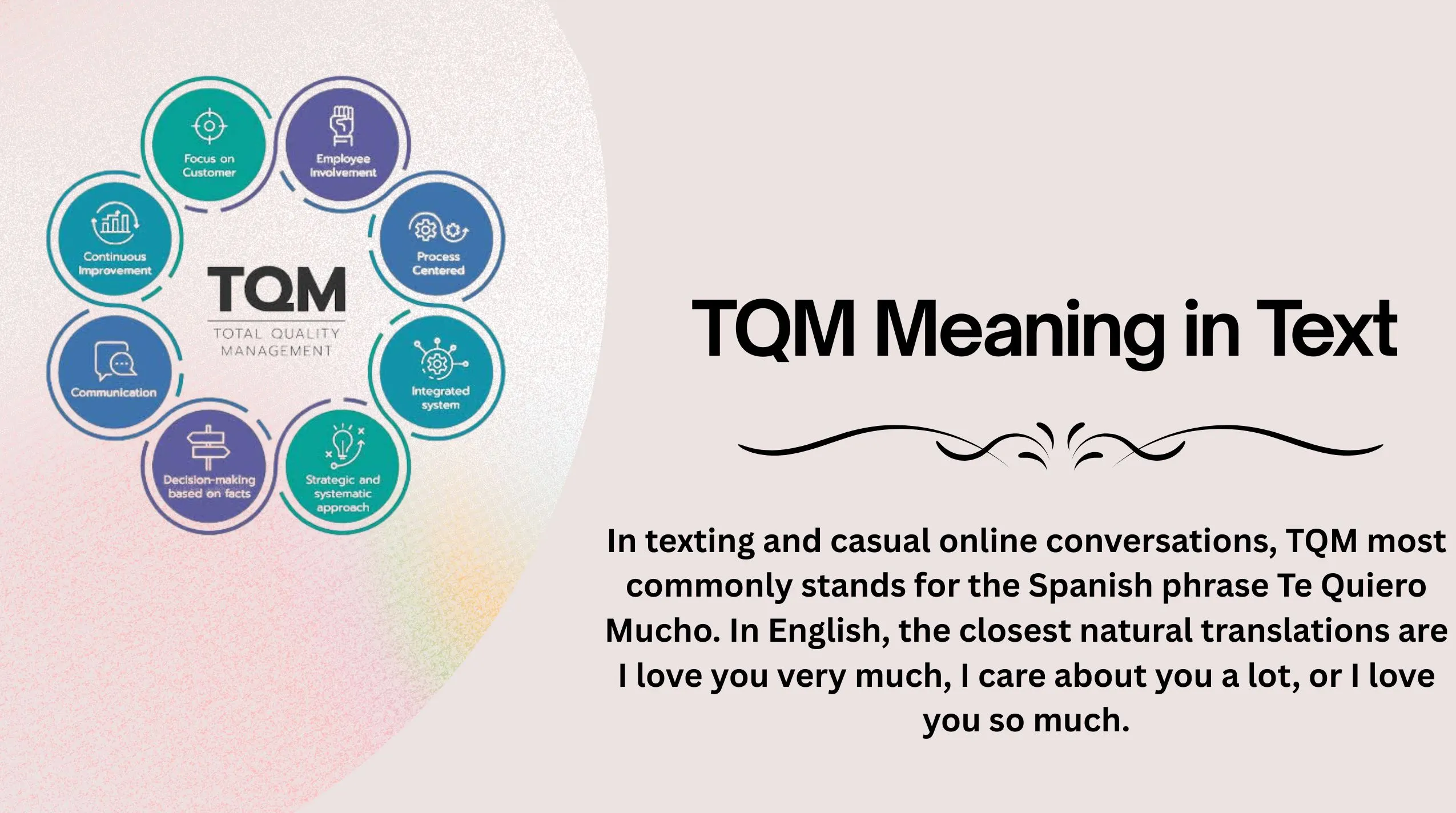
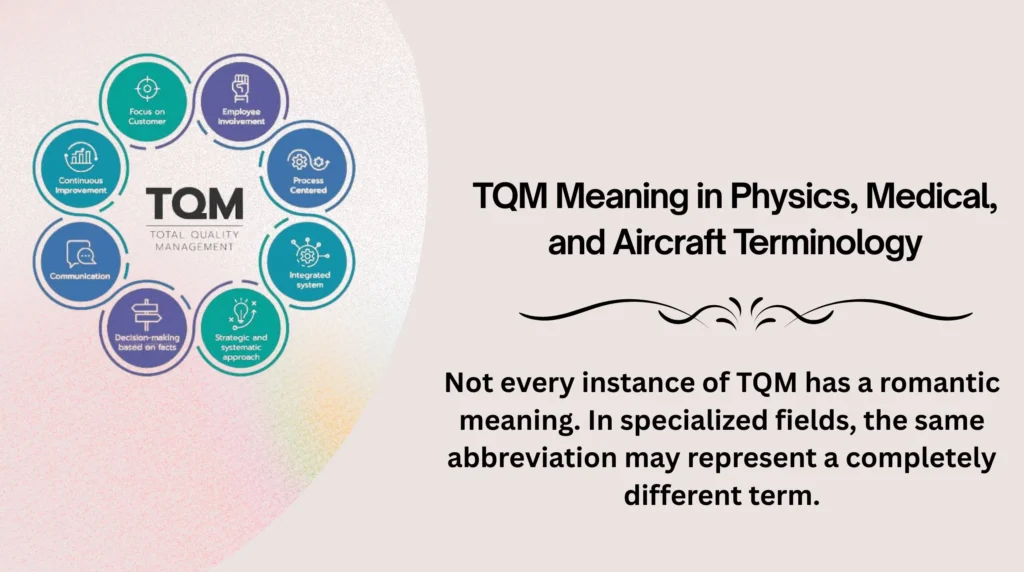
In business, TQM often means Total Quality Management, a management approach focused on improving quality across an organization.
Therefore, seeing TQM in a company presentation does not mean someone suddenly started writing Spanish love messages at work. Context changes everything.
Academic or technical settings
TQM can also appear as an abbreviation in specialized subjects. Its meaning may depend on the particular field, institution, or document.
The safest approach is to look at the surrounding words. Ask yourself: Is this a personal conversation, a social media post, or a professional document? That simple question often reveals the intended meaning immediately.
TQM Meaning in Chat, WhatsApp, Instagram, and TikTok
On messaging and social media platforms, TQM is usually an affectionate abbreviation. You may encounter it on WhatsApp, Instagram, TikTok, Snapchat, Facebook, or ordinary text messages.
On WhatsApp, for example, someone may send:
Thank you for being there for me. TQM.
This sounds warm and personal.
On Instagram, TQM might appear in a comment such as:
TQM bestie!
In that case, the writer may be expressing strong friendship rather than romantic love.
On TikTok, users may include TQM in comments or captions, especially when interacting with friends or Spanish-speaking creators.
The platform itself does not usually determine the meaning. The relationship between the people and the surrounding message matter more.
Here are a few examples:
Romantic:
I can’t wait to see you tomorrow. TQM.
Friendly:
You seriously made my whole day. TQM!
Family:
Happy Mother’s Day, Mom. TQM.
Grateful:
Thanks for helping me with everything. TQM.
Notice how the same abbreviation can communicate slightly different emotions.
Emoji use can also provide clues. A heart, affectionate nickname, romantic message, or discussion about relationships may suggest that TQM is being used romantically. However, an emoji alone is not enough to establish someone’s intentions.
If you are unsure, do not panic. You can simply ask what they mean or respond warmly without making assumptions.
TQM Meaning in Physics, Medical, and Aircraft Terminology
Not every instance of TQM has a romantic meaning. In specialized fields, the same abbreviation may represent a completely different term.
Physics
TQM is not one universally fixed physics abbreviation with a single meaning across all contexts. Specialized papers, research groups, educational materials, and technical documents can use abbreviations differently.
If you encounter TQM in a physics paper, lecture, formula, or research discussion, the surrounding material should be used to identify the intended definition. It would be a mistake to automatically interpret it as Te Quiero Mucho.
Medical terminology
Medical abbreviations can be especially context-dependent. TQM may appear in specific institutional documents or specialized terminology, but it is not safe to assign one universal medical definition without knowing the source.
When reading medical material, always use the definition provided by the document or medical professional rather than relying on a general internet abbreviation list.
Aircraft and aviation terminology
Aviation also uses many abbreviations and codes. If TQM appears in an aircraft manual, flight-related document, maintenance record, or aviation communication, it should be interpreted according to that specific technical system.
This is why context is essential. A three-letter abbreviation can mean one thing in a WhatsApp message and something entirely different in an aircraft manual.
The key lesson is simple: TQM in a personal chat and TQM in a technical document should never automatically be treated as the same abbreviation.
Common Misconceptions About TQM
One common misconception is that TQM always means I love you very much. That is often true in casual Spanish-language texting, but it is not universally true.
Another misunderstanding is that TQM is always romantic. It is not. A close friend, sibling, parent, or other family member may use it affectionately.
Some people also assume that TQM is an English abbreviation. It is actually based on Spanish words: Te Quiero Mucho.
Another mistake is thinking that capitalization changes the meaning. TQM, tqm, and Tqm generally refer to the same expression when used in casual Spanish texting.
People may also confuse TQM with ILY. Both can express love, but they come from different languages and have different forms. ILY is an English abbreviation for I love you, while TQM comes from the Spanish phrase Te quiero mucho.
Finally, some readers see TQM in a business setting and assume it must have the same affectionate meaning. In management, TQM commonly refers to Total Quality Management, which has nothing to do with romantic messages.
The best way to avoid confusion is to examine the entire message instead of focusing on the abbreviation alone.
Similar Terms and Alternatives
Several abbreviations and expressions can communicate feelings similar to TQM.
| Term | Common Meaning | Typical Use |
|---|---|---|
| TQM | Te Quiero Mucho | Spanish affection |
| ILY | I Love You | English texting |
| ILU | I Love You | Casual English chat |
| XOXO | Hugs and kisses | Affectionate messages |
| Te quiero | I love you / I care about you | Spanish |
| Te amo | I love you | Spanish, often stronger or more explicitly romantic |
| Love ya | Casual form of I love you | English |
| TYSM | Thank You So Much | Gratitude rather than love |
These expressions are not perfect substitutes.
For example, TYSM expresses gratitude, while TQM expresses affection. XOXO can be playful and affectionate, but it does not necessarily communicate the same emotional meaning as TQM.
In Spanish, te quiero and te amo can also have different emotional nuances depending on the speaker, country, relationship, and context.
If someone uses TQM, the safest interpretation is that they are communicating warmth, affection, or love. The exact level of romantic meaning should be determined from the broader conversation.
How to Respond When Someone Says TQM
Your response should match the relationship and emotional tone of the conversation.
If you feel the same way, you can reply naturally:
- TQM too!
- Aww, tqm ❤️
- I love you too!
- Right back at you!
- You mean a lot to me too.
If you are close friends, you could keep it friendly:
- TQM bestie!
- Love you too, buddy!
- You’re the sweetest.
- Same here!
If you are not sure whether the person is being romantic, avoid making a major assumption. A warm but neutral response can work well:
Aww, that’s sweet!
Or:
That means a lot. Thank you!
If someone you are dating sends TQM and you want to understand exactly what they mean, you can simply ask:
Aww, what does TQM mean to you?
This can even turn into a fun conversation.
The most important rule is to consider the relationship. A message from your longtime best friend may require a very different response from the same abbreviation sent by someone you recently matched with on a dating app.
Differences Between TQM and Similar Words
TQM can look similar to other expressions of affection, but there are important differences.
TQM vs. ILY:
TQM comes from Spanish, while ILY is an English abbreviation for I love you. Both can express strong affection.
TQM vs. TYSM:
TQM expresses affection, while TYSM means thank you so much. One focuses on emotional attachment; the other focuses on gratitude.
TQM vs. XOXO:
XOXO represents hugs and kisses and can be playful or affectionate. TQM directly comes from a phrase expressing strong affection.
TQM vs. Te Amo:
Both are Spanish expressions associated with love. Their exact emotional use can vary by region and relationship, so context matters.
TQM vs. Te Quiero:
TQM is simply a shortened digital form based on Te Quiero Mucho. It adds mucho, meaning a lot or very much.
These differences matter because abbreviations often lose some of the nuance found in complete phrases. Someone choosing TQM may simply want a quick, affectionate way to communicate without typing the full sentence.
TQM in Online Conversations and Dating Apps
TQM can be especially interesting on dating apps because emotional abbreviations may carry more weight in romantic conversations.
Imagine you have been chatting with someone for several days. They suddenly write:
Goodnight, TQM.
That could be a clear sign of affection, especially if your conversation has already become romantic.
However, you should not treat one abbreviation as definitive proof that someone is in love. People use language differently. Some are naturally affectionate, while others use TQM casually.
On dating apps, context can include:
- How long you have been talking
- Whether the conversation is romantic
- Whether they use affectionate language often
- Whether they call you romantic nicknames
- Whether they use TQM with other friends
- What they say immediately before and after it
If the person frequently sends affectionate messages, TQM may simply fit their communication style.
If the abbreviation appears suddenly after a deeply personal conversation, it could carry more emotional weight.
The best approach is not to overanalyze three letters. Look at the complete conversation and the person’s behavior.
If you want to respond romantically, you might say:
TQM too. You are becoming one of my favorite people.
If you want to keep things playful:
Okay, now I need to know how many Spanish abbreviations you have been hiding from me.
A little curiosity can be much better than making assumptions.
Conclusion
The most common TQM meaning in text is Te Quiero Mucho, a Spanish expression used to communicate strong affection, care, or love. It can appear in text messages, WhatsApp chats, Instagram comments, TikTok conversations, and other informal online spaces.
TQM is not automatically romantic. Friends and family members may use it too.
The surrounding conversation, relationship, and tone usually reveal what the sender intends.
At the same time, TQM can have completely different meanings in professional and technical environments.
In business, for example, it commonly refers to Total Quality Management. Specialized fields may also use the abbreviation in their own ways.
So, when you see TQM, think about context first. In a personal Spanish-language chat, affection is probably the answer. In a technical document, look for the field-specific definition.

Hi, I’m Eleanor Brooks, an English language writer passionate about making vocabulary, grammar, idioms, and everyday expressions easy to understand. I create clear, accurate, and practical content that helps learners build confidence and improve their English every day.